Address:
6F No.18 Yucai Rd, Dalingshan Town, Dongguan, Guangdong, China
Business Hours: Mon–Fri 9AM–6PM (GMT+8)
Address:
6F No.18 Yucai Rd, Dalingshan Town, Dongguan, Guangdong, China
Business Hours: Mon–Fri 9AM–6PM (GMT+8)
If you’re a sourcing manager at a medical device company, you’ve probably been handed the task of finding documentation for a battery you barely specified — and discovered too late that the supplier’s “IEC 62133” certificate covers a different cell configuration than what’s actually going into your device. By then it’s a delay in your regulatory submission, not just a paperwork gap.
Medical devices carry a higher bar for battery safety than almost any other product category, for an obvious reason: a battery failure isn’t just a product defect, it can interrupt patient care or cause direct harm. Regulators, hospitals, and distributors all expect documentation that goes beyond the standard consumer certifications. If you’re sourcing lithium batteries for a medical device — whether it’s a portable monitor, an infusion pump, a diagnostic device, or a wearable — understanding which standards actually apply, and which your supplier needs to demonstrate compliance with, is essential before you commit to a design or a production run.
A consumer power bank and a battery inside a patient monitor might use the same cell chemistry, but the surrounding requirements diverge sharply. Medical devices are typically classified by risk (e.g., under frameworks like the EU MDR or FDA device classes), and the battery — as a critical component — inherits scrutiny from that classification. Buyers need to think about three layers of compliance at once: the cell/battery safety standard, the finished medical device standard the battery will be integrated into, and the transport/shipping regulations that apply regardless of end use.
This is the baseline safety standard for portable lithium-ion and lithium-polymer cells and batteries, covering construction requirements and safety tests such as short-circuit, overcharge, crush, and thermal abuse. It applies broadly across consumer and medical portable electronics and is typically the starting certification any credible battery manufacturer should hold.
Required for transporting lithium batteries by air or sea, regardless of end application. It covers tests like altitude simulation, thermal cycling, vibration, shock, and external short circuit. Every medical device battery shipment needs this documentation, and it should be specific to your exact cell/pack configuration, not a generic report from a different product.
This is the general safety standard for medical electrical equipment, and it’s where the battery stops being evaluated on its own and starts being evaluated as part of the finished device. Sections relevant to battery-powered devices include requirements around battery compartment isolation, protection against battery-related hazards (overheating, leakage, fire), and — for home-use devices — the IEC 60601-1-11 collateral standard covering the home healthcare environment. Your device manufacturer (or you, if you’re the brand owner) will need the battery’s technical file to support this certification; the battery supplier alone can’t certify to 60601, but their documentation feeds directly into it.
In practice, this means the battery supplier’s datasheet alone won’t get your device through IEC 60601-1 certification. Your regulatory team will need access to the supplier’s failure mode data, BMS behavior under fault conditions, and thermal runaway test results — and many cell-level suppliers simply don’t keep this level of detail in their standard, public-facing documentation. It’s worth asking for it explicitly, and early, rather than assuming it will surface when your test lab asks for it.
These aren’t battery standards themselves, but they matter because medical device manufacturers are required to conduct formal risk management (ISO 14971) covering every component, including the battery. A battery supplier who can provide a failure mode analysis (FMEA), cycle life data, and documented thermal runaway behavior makes this process far easier — and a supplier who can’t produce this data at all is a sourcing risk regardless of what certificates they hold.
UL 1642 covers lithium cells specifically, and UL 2054 covers battery packs, including additional criteria around charging circuits and multi-cell configurations. These are widely referenced in North American medical device submissions and are often requested by device OEMs even when not strictly mandated by the FDA for a given device class.
For medical devices, the battery is never “just a component” — it’s a safety-critical part that regulators, hospitals, and your own risk management process will scrutinize closely. A supplier who understands this distinction, and can produce the documentation to match, is worth prioritizing over one offering a lower price with only consumer-grade certifications. Locking in battery specifications and traceability early, and building a change-control agreement into your supply contract, will save significant regulatory rework later in the device’s lifecycle.
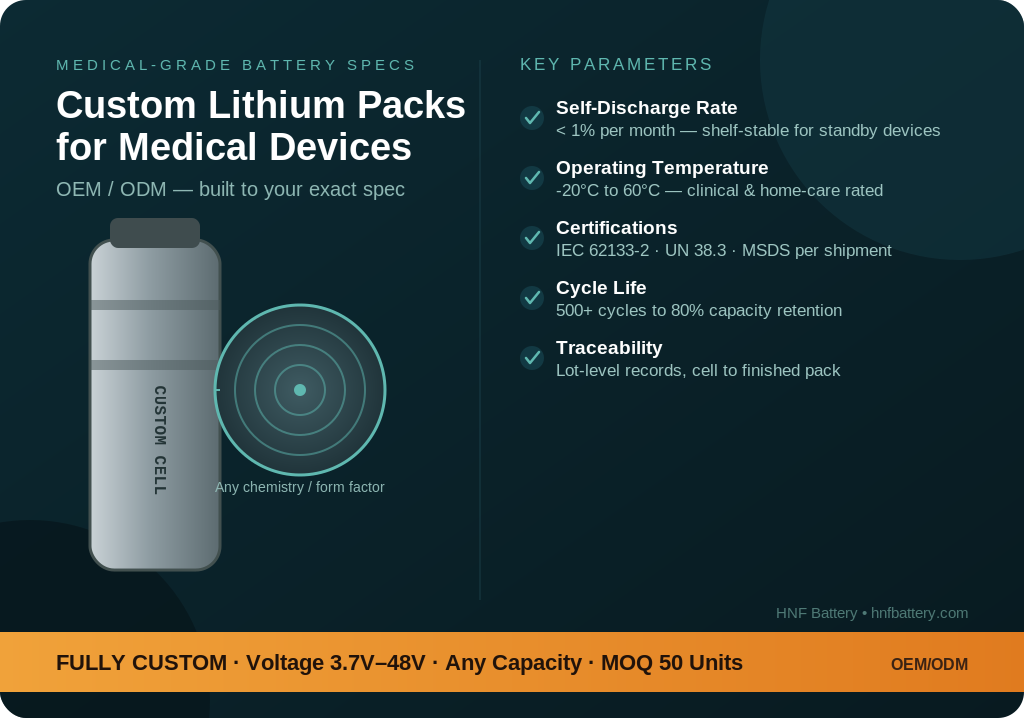
HNF Battery maintains documentation for CE, RoHS, IEC 62133-2, and UN 38.3 across our standard cell configurations, with MSDS provided per shipment. We also support lot-level traceability from cell to finished pack and issue change-control notifications on any cell source or BMS firmware modification. If your device requires additional data — cycle life reports or thermal abuse test results, for example — tell us your spec and target market, and we’ll let you know upfront what we can provide directly and where you’d need to commission additional third-party testing. That clarity early is worth more than a supplier who says yes to everything and can’t back it up later.
Have a spec in hand? Send us your voltage, capacity, and target market, and we’ll reply with our current certification documents and cell sourcing details for that configuration. 📧 sales@hnfbattery.com 💬 WhatsApp: +86 134-8090-2696 📥 Or send your spec via our contact form: hnfbattery.com/contact-us
This guide is for general informational purposes and does not constitute regulatory or legal advice. Requirements vary by device classification and target market — consult your regulatory affairs team or a qualified consultant for guidance specific to your device.
