Address:
6F No.18 Yucai Rd, Dalingshan Town, Dongguan, Guangdong, China
Business Hours: Mon–Fri 9AM–6PM (GMT+8)
Address:
6F No.18 Yucai Rd, Dalingshan Town, Dongguan, Guangdong, China
Business Hours: Mon–Fri 9AM–6PM (GMT+8)
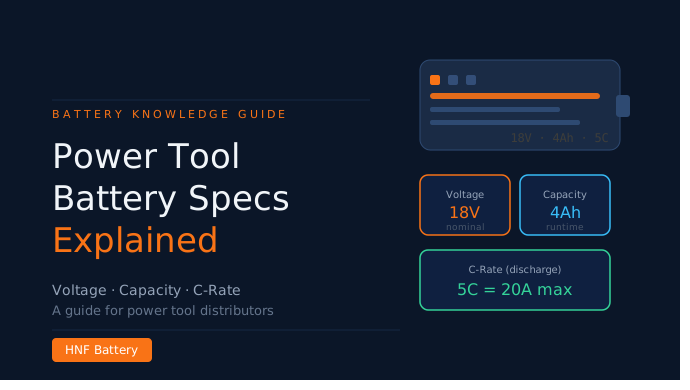
If you distribute or retail power tools, you’ve seen dozens of battery spec sheets. But can you actually read one?
Most buyers focus on voltage and price — and miss the two parameters that determine whether a battery performs reliably in the field or comes back as a warranty claim.
This guide breaks down the three core specs every power tool battery distributor needs to understand: voltage, capacity, and C-rate. By the end, you’ll know exactly what to look for when evaluating replacement Li-ion battery packs — and what questions to ask your supplier.
Voltage (V) represents the electrical potential of a battery system. For power tools, it determines compatibility with the tool’s motor.
Common power tool battery voltages include 12V, 18V, 20V, 36V, and 40V. But here’s what most distributors don’t realize: 18V and 20V Max batteries are often electrically identical.
Brands like DeWalt label their 18V nominal batteries as “20V Max” — referring to the peak voltage when fully charged. The nominal operating voltage is still 18V. This is a marketing distinction, not a technical one.
Key voltage facts for distributors:
Always match replacement battery voltage exactly to the original tool specification. A mismatch — even by 2V — can damage the tool motor or trigger safety shutoffs.
Capacity, measured in Amp-hours (Ah), tells you how much energy the battery stores — and directly determines runtime.
A simple formula helps clarify this:
Runtime (hours) = Capacity (Ah) ÷ Tool Current Draw (A)
For example: a 4Ah battery powering a drill drawing 8A continuously will run for approximately 30 minutes before needing a recharge.
Choosing the right capacity for your product line:
| Application | Recommended Capacity |
|---|---|
| Light duty (drills, drivers) | 2.0 – 3.0 Ah |
| Medium duty (jigsaws, sanders) | 3.0 – 4.0 Ah |
| Heavy duty (circular saws, grinders) | 4.0 – 6.0 Ah |
| Extended runtime / professional use | 6.0 Ah+ |
Higher capacity is not always better. A 6Ah battery adds significant weight to a handheld tool, increasing user fatigue over a full workday. Help your customers match capacity to their actual application — this reduces returns and increases satisfaction.
C-rate (discharge rate) is the spec most distributors never ask about — and the one most responsible for battery failures in demanding applications.
C-rate describes how quickly a battery can safely discharge relative to its capacity.
Discharge current (A) = Capacity (Ah) × C-rate
So a 4Ah battery with a 5C rating can safely deliver up to 20A continuously. The same 4Ah battery with a 2C rating maxes out at 8A.
Why does this matter for power tools?
Heavy-duty power tools like circular saws and angle grinders can draw 20–30A or more during peak load (mid-cut, under stress). If the battery’s C-rate cannot support that current demand, you get:
This is the primary reason cheap replacement batteries fail quickly in professional use — not because of low capacity, but because of low-quality cells with insufficient C-rate ratings.
What to ask your battery supplier:
A reputable manufacturer will answer these questions directly. If they can’t — that’s a red flag.
Now that you understand the three core specs, here’s a practical checklist for evaluating any replacement Li-ion battery pack:
✅ Voltage match — Confirm nominal voltage matches the original battery exactly
✅ Capacity for application — Choose Ah based on tool type and user workflow, not maximum available
✅ C-rate verified — Request cell specifications and confirm discharge rate supports peak tool demand
✅ BMS quality — A good Battery Management System protects against overcharge, over-discharge, short circuit, and temperature extremes
✅ Certifications — For international distribution, confirm UN38.3 certification (required for air freight) and request MSDS documentation
✅ Cycle life — Quality replacement batteries should deliver 500+ charge cycles at 80% capacity retention
Q: Can I use a higher Ah battery than the original? Yes, in most cases. A higher capacity battery with matching voltage is compatible and will simply provide longer runtime. Check the tool manufacturer’s maximum supported Ah rating if specified.
Q: Why does my replacement battery get hot during use? Heat is usually caused by high internal resistance — a sign of low-quality cells or insufficient C-rate for the application. A well-matched replacement battery should run warm, not hot.
Q: What does BMS stand for and why does it matter? BMS stands for Battery Management System. It’s the circuit board inside the battery pack that monitors and controls charging, discharging, temperature, and cell balance. Without a quality BMS, a lithium battery is both unreliable and potentially unsafe.
Q: How do I know if a replacement battery is compatible with my brand? Check that voltage, connector type, and physical dimensions match the original. Reputable OEM replacement manufacturers will list compatibility by brand and model number.
At HNF Battery, we manufacture compatible and custom Li-ion battery packs for leading power tool brands including Makita, Milwaukee, RYOBI, Black+Decker, HITACHI, and AEG. All packs are built with verified cells, quality BMS protection, and UN38.3 certification — with MSDS documentation available on request.
Whether you’re sourcing standard replacement SKUs or need custom OEM battery packs for your brand, we work directly with distributors and retailers across Europe and North America.
Contact us to request specifications, samples, or bulk pricing: 📧 sales@hnfbattery.com 💬 WhatsApp: +86 134 8090 2696 🌐 Browse our battery catalog →
