Address:
6F No.18 Yucai Rd, Dalingshan Town, Dongguan, Guangdong, China
Business Hours: Mon–Fri 9AM–6PM (GMT+8)
Address:
6F No.18 Yucai Rd, Dalingshan Town, Dongguan, Guangdong, China
Business Hours: Mon–Fri 9AM–6PM (GMT+8)
what-is-a-lipo-battery
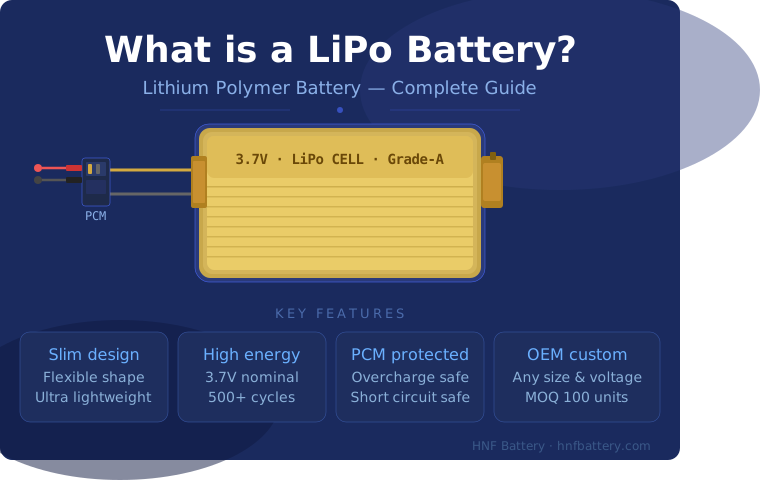
Lithium polymer batteries — commonly known as LiPo batteries — have become one of the most widely used power sources in modern electronics. From drones and wearables to medical devices and custom OEM products, LiPo batteries offer a unique combination of lightweight design, high energy density, and flexible form factors that make them the go-to choice for engineers and product designers worldwide.
In this guide, we’ll cover everything you need to know about LiPo batteries: what they are, how they work, their key advantages, common applications, and how to choose the right one for your product.
A LiPo battery is a type of rechargeable lithium-ion battery that uses a polymer electrolyte instead of a liquid electrolyte. This key difference allows the battery to be manufactured in a wide variety of shapes and sizes — including ultra-thin, flexible, and custom form factors that are simply not possible with traditional cylindrical cells like 18650s.
The nominal voltage of a single LiPo cell is 3.7V, with a fully charged voltage of 4.2V and a cutoff discharge voltage of around 3.0V. LiPo batteries are available in a wide range of capacities, from as small as 100mAh for tiny IoT sensors up to 10,000mAh or more for high-drain applications.
Like all lithium-ion batteries, LiPo batteries store and release energy through the movement of lithium ions between the anode and cathode during charge and discharge cycles.
What makes LiPo unique is its electrolyte: instead of a liquid solution, it uses a solid or gel-like polymer material. This allows the battery to be sealed in a soft, flexible pouch rather than a rigid metal casing. The result is a battery that is lighter, thinner, and more adaptable in shape than its cylindrical counterparts.
Most LiPo batteries also include a PCM (Protection Circuit Module) or BMS (Battery Management System) that protects against:
This protection circuitry is essential for safe operation, especially in consumer electronics and medical applications.
LiPo batteries can be manufactured as thin as 2–3mm, making them ideal for slim devices like smartwatches, credit card-sized trackers, and thin medical patches. Their soft pouch construction also means they weigh significantly less than equivalent cylindrical cells.
Unlike cylindrical or prismatic cells, LiPo batteries can be produced in virtually any shape — rectangular, L-shaped, curved, or even custom contoured designs. This gives product designers maximum freedom when integrating a battery into a tight or unusual enclosure.
LiPo batteries offer excellent energy density, typically in the range of 200–250 Wh/kg. This means more stored energy per gram of battery weight — a critical advantage for portable and wearable applications.
LiPo batteries retain their charge well when not in use, losing roughly 1–2% of capacity per month under normal storage conditions. This makes them suitable for products that may sit on a shelf for extended periods before being used.
With proper charging and storage practices, a quality Grade-A LiPo cell can deliver 500 or more full charge-discharge cycles before capacity drops to 80% of its original rating. In low-depth-of-discharge applications, cycle life can exceed 1,000 cycles.
LiPo batteries are used across a wide range of industries and product categories:
Consumer Electronics Smartphones, tablets, Bluetooth earbuds, smartwatches, and portable speakers all rely on LiPo cells for their slim profiles and high capacity.
Wearable Devices Fitness trackers, smart glasses, and health monitoring patches require ultra-thin, lightweight batteries that conform to the human body — a perfect fit for LiPo technology.
Drones and RC Devices High-discharge LiPo packs are the standard power source for consumer and professional drones, RC cars, and FPV racing equipment due to their excellent power-to-weight ratio.
GPS Trackers and IoT Sensors Small-capacity LiPo cells (100–1000mAh) power GPS trackers, asset monitoring devices, and wireless sensors where long battery life in a compact package is essential.
Medical Devices LiPo batteries are widely used in portable medical equipment, including hearing aids, insulin pumps, and wearable patient monitors. Their slim form and reliable performance make them ideal for life-critical applications.
Custom OEM Products Manufacturers across industries rely on custom LiPo packs to power their proprietary devices — from smart home products to industrial handheld tools.
When selecting a LiPo battery for your product, consider the following factors:
Capacity (mAh) Higher capacity means longer runtime. Match the capacity to your device’s power consumption and the desired battery life between charges.
Voltage Single-cell LiPo packs operate at 3.7V nominal. For higher voltage requirements, cells can be connected in series (2S = 7.4V, 3S = 11.1V, etc.).
Dimensions LiPo batteries are typically specified by thickness × width × length in millimeters (e.g., 103450 = 10mm × 34mm × 50mm). Confirm the available space in your enclosure before selecting a cell size.
Discharge Rate (C Rating) For high-drain applications like drones or power tools, choose a cell with a sufficient C rating to handle peak current demands without damaging the battery.
Protection Circuit For consumer products, always specify a battery with a built-in PCM or BMS. For raw cell applications in industrial or custom battery packs, protection circuitry can be added externally.
Certifications For export and retail products, ensure your LiPo battery supplier can provide CE, RoHS, and UN38.3 certifications. These are required for shipping lithium batteries by air and for sale in most international markets.
At HNF Battery, we specialize in custom LiPo battery manufacturing for OEM and B2B customers worldwide. Based in Dongguan, China — the heart of global battery manufacturing — we offer:
Whether you need a standard off-the-shelf LiPo cell or a fully customized battery pack engineered to your exact specifications, our team is ready to help.
LiPo batteries have revolutionized the way we power portable electronics. Their slim design, flexible shape, high energy density, and long cycle life make them the battery of choice for engineers and product designers across virtually every industry.
If you’re sourcing LiPo batteries for your next product — whether a small wearable, a GPS tracker, or a high-volume OEM project — choosing the right manufacturer is just as important as choosing the right cell.
Ready to get started? Contact HNF Battery today for a free sample or custom quote.
📧 sales@hnfbattery.com 📱 WhatsApp: +86 134-8090-2696 🌐 www.hnfbattery.com
